|
OCH LIBRARY
MENTAL HEALTH/HEALTH |
The Manual
Of Common Communicable Diseases in Shelters
As a result of the Coalition's advocacy, The
Ohio Department of Health has sent copies of the Manual Of Common
Communicable Diseases in Shelters to each shelter/transitional
housing program that receives funding from ODOD.
If your program has not received a copy of this manual, please
contact the Coalition. |
Edited by James J. O'Connell, M.D.
and Janet Gioth, R.N., M.S.
Boston Health Care for the Homeless Program
The Ohio Coalition For The Homeless
1066N. High Street
Columbus/ Ohio 43201 -2440 (614)291-1984
POINTS TO CONSIDER
WHEN DRAFTING A POLICY
FOR COMMUNICABLE DISEASES
1. Whether detection of a communicable disease occurs at the
time of intake or after a person has been admitted to the shelter,
consult with your city/county health department for
a. Treatment of the disease
b. Quarantine procedures
c. Referral to appropriate medical facility (TB clinic, hospital,
etc.)
2. If the person is in the period of contagion (disease can
be transmitted through casual contact), and appropriate medical
treatment facilities in the area do not include some semblance
of shelter (e.g. admittance into a TB clinic or hospital), possible
means of quarantine to consider to shelter the person:
a. Setting aside space or a room in the shelter for the individual.
3. Annual training of staff
a. Detection of common communicable diseases amongst the homeless
population you serve (i.e. females, males, children)
b. Appropriate responses upon detection, including treatment
within the shelter (e.g. head lice, chicken pox), sanitation
procedures for bed linen, clothing and other affected items,
networking with medical personnel to not only address the disease
but to provide shelter for the person if quarantine is necessary.
c. Asking the right questions at intake to accurately assess
the progression of a communicable disease.
4. If the person had to be quarantined, readmittance of a
person to the shelter once a medical professional has deemed
the person out of the contagion state.
5. Preventative measures for communicable diseases
a. Daily cleaning of bathrooms, weekly cleaning of bed linens,
towels, etc.
b. Use of rubber gloves when in contact with body fluids or when
cleaning facilities.
c. Signs posted advocating better personal hygiene, washing of
hands, covering mouth and nose when sneezing/coughing, etc.
6. Consult The Manual of Common Communicable Diseases in
Shelters and/or your local health department for other suggestions
for treatment/preventive measures.
LIMA'S SAMARITAN HOUSE
INFECTION CONTROL POLICY
Effective 2-1992
Purpose: To maintain general health and cleanliness, and to
prevent the spread of infections.
General
1. Living and office areas are cleaned on a regular basis.
2. Pest control services are provided monthly by a contract agency.
3. Food storage and preparation are maintained according to Health
Department requirements.
Residents
1. All residents are checked for head lice on admission.
2. Residents are given information on cleanliness rules and issues
during the orientation period.
3. Residents are to report any known or suspected communicable
disease to staff.
Staff
1. Staff will receive an initial training in Infection Control
principles and communicable diseases, with an update yearly.
2. Documentation of training provided will be maintained by the
Director or designee.
3. The booklet "Communicable Diseases" contains information,
spread of and treatment for common childhood problems and other
diseases, and is available in the main office.
4. A staff member with a known or suspected communicable disease
will report to the Director, who will then consult with the Health
Department.
5. Any question or concern about communicable disease is to be
referred to the Alien County Health Department (228-4457).
Discovery of Communicable Disease
If a resident has a known or suspected communicable disease,
staff will consult the Alien County Health Department immediately.
Any restriction or modifications of activities or living arrangements
will be made as needed after consultation with the Health Department
officials, taking into consideration:
1. Specific disease and how spread.
2. Health and behavior status of affected resident.
3. Health and behavior status of other residents.
Lima's Samaritan House will not discriminate against residents
with communicable disease, but will take appropriate action to
protect the safety and health of residents and staff.
OPERATIONS
STANDARD #2
Intake of Clients Criteria for Admittance
 |
INTAKE |
|
Policy
The Mission will establish and implement a consistent intake
procedure for those persons seeking shelter at the Mission.
Rationale
The Mission believes that one of its obligations is to ensure
proper accountability to donors, funders and client/guests. A
consistent intake process will provide demographic and statistical
information for those funders and donors who require such data
as a prerequisite for financial support. In addition, the Mission
keeps emergency information on each client/guest so that if an
emergency occurs, proper, information is provided to medical
personnel, mental health workers and relatives of the client/guest.
Finally, the intake process will assist the Mission to screen
persons who seek services, so that those who are barred from
the Mission or who may present a danger can be identified.
Implementation
1. A person seeking assistance from the Mission for the first
time will be interviewed and an intake form completed.
2. The applicant will be required to produce picture identification.
Those without picture identification will be required to obtain
such prior to being served. The Mission Supervisor and the Director
of Men's Services will be able to provide information about obtaining
ID.
3. After the intake form is completed, the interviewer will provide
the applicant with a copy of the Mission's rules. The interviewer
will verbally review the rules with the applicant and the applicant
will be required to sign that he/she will comply with the Mission's
rules. Refusal to sign will result in withholding of services.
4. Once admitted into the Mission's shelter program, client/
guests must return each night between 5:00 p.m. and 6:30 p.m.
to sign their intake folder and to retain their bed for that
evening. Any beds unclaimed at 6:30 will be made available to
new or returning client/guests.
5. Client/guests who return to sign their folders each evening
and who abide by Mission rules and policies may retain their
bed for an indefinite period of time.
6. Client/guests who provide false information during the intake
process will result in the permanent barring of that individual.
BETHANY HOUSE SERVICES
CINCINNATI, OHIO
2.1. 11
INTAKE PROCEDURES
Bethany House Services operates an emergency shelter for those
who have been left homeless or stranded without shelter because
of emergency situations. A telephone interview is conducted on
all persons requesting shelter. Bethany House Services can not
accept guests in the shelter who are
- In danger of abuse
- Substance abusers
- Psychiatric referrals who are dangerous to themselves or to
others
- Unemancipated minors-women under 18 years of age still under
the jurisdiction of a parent or guardian.
The Executive Director, or a staff member designated by the Director,
may make an exception of this policy.
- "Former guests who have not participated in the Outreach
program. Acceptance of any former guest requires the approval
of the Outreach Worker or a Shelter Advocate if the Outreach
Worker can not be contacted. In the event that neither the Outreach
Worker nor a Shelter Advocate can be reached, the on-call staff
person should determine whether the former guest should be accepted.
- Re-admittance requests after serious violation of Shelter policies
without approval pf the Director or designated staff person.
Note:
If a two-parent family is in need of shelter they may be considered
for the Families In Transition (F. I. T.) Program of Bethany
House Services. Refer to the policy by this title (F.I.T.)for
additional Information on the policy and procedures to be followed
for two-parent families.
PURPOSE:
- To assure that all persons accepted into the Bethany House
Services shelter program:
(a) Are in, need of Bethany House Services assistance
(b) Understand and accept the requirements of participation
in the program.
(c) Are able to actively seek housing and
... / missing part ? /...
9. Upon acceptance of the guest for the Bethany House Services
shelter program, the House Manager should make arrangements with
the guest regarding directions to Bethany House Services shelter
and expected arrival time. The House Manager also assigns the
guest to a Shelter Advocate maintaining equal case load for each
Shelter Advocate. Guests entering under specifi programs such
as F.I.T. or other referral programs are assigned to the specific
staff person designated as responsible for that particular program.
10. Specific orientation steps outlined in the guest checklist
should be carried out by this House Manager on duty when the
guest arrives. The arrival section of the Client Date Record
should be completed by the House Manager on duty and then placed
in the guest, folder prepared and containing the other forms
specified for use with each guest. Current guest files are kept
in the main office except when in used by Shelter Advocates or
other staff persons.
Approved ________________
Title: ______Executive Director
Date: ____5 / 2 /_90________
BETHANY HOUSE SERVICES
CINCINNATI, OHIO
2.1. 3
ASSISTANCE CRITERIA FOR EMERGENCY SHELTER
POLICY:
The staff of Bethany House Services Shelter has developed
a set of criteria based on our philosophy, purpose and previous
experiences. We believe these criteria far emergency shelter
assistance will enable us to effectively assist homeless persons
who will benefit from their stay at Bethany House. Bethany House
Services accepts all persons (as shelter space permits) regardless
of race, creed, color or age who meet these criteria. To be accepted
as a guest at Bethany House Services for emergency shelter the
following criteria must be fulfilled:
Applicant must:
1. Be female, 16 years of age or older.
2. Have an income or desire to establish an income.
3. Have a desire to make positive life changes and to use available
persons and community resources.
4. Be able to complete her stay at Bethany House within one month
or less.
5. Be able to live in a group situation.
Bethany House Services Shelter is not able, to house:
1. Male children older than 12 year of age.
2. Women who are drug or alcohol dependent.
3. Women who are recovering alcoholics ,or drug addicts who are
not attending counseling or A. A.
4. Women who are in emotional crisis who are not in follow-up
counseling with a referring agency
5. Women who are dangerous to themselves and/or others.
6. Women/families who may endanger themselves and/or others in
the shelter due to an assailant or possible assailant in pursuit
of her or children accompanying her.
Final decision regarding acceptance into the Bethany Mouse
Services emergency shelter program will be based on:
1. Staff evaluation.
2. Number of available beds.
3. Availability of shelter advocacy staff.
Any exception to the above criteria for acceptance into the program
can be made only by the Executive Director or her designee
PURPOSE
- To assure resources of Bethany House Services Shelter program
are consistently available to those persona most in need of emergency
shelter and most able to participate appropriately in the Bethany
House Services Shelter program.
PPROCEDURE:
A telephone interview is ordinarily conducted by a Bethany House
Services Shelter staff person directly with the person seeking
shelter to assess the applicant's situation regarding need for
housing, interest and acceptance, of the Bethany House Services
Shelter program and policies and ability of the person to: live
in a group situation, seek housing and re-establish independent
living. Refer to the policy on intake interview for additional
information regarding policies and procedures for assessment
and acceptance into the Bethany House Services emergency shelter
program.
Approved ________________
Title: ______Executive Director
Date: ____6 / 19 /_90________
STANDARD
#3
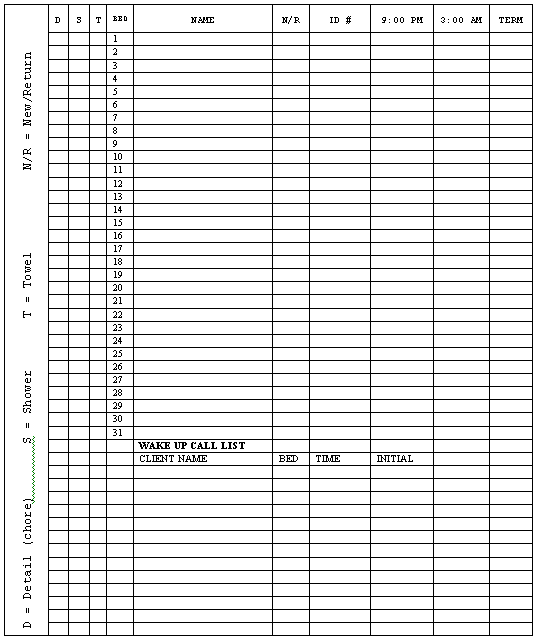
Attendance List
Registration Form
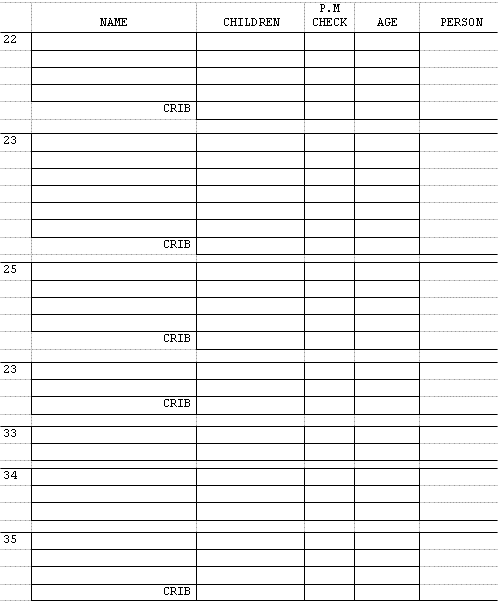
This form is used by the Guest Attendant when takings names
for the night. It is also used by the Night Monitor when recording
guests' stays on record cards. These forms are kept on file for
future reference.
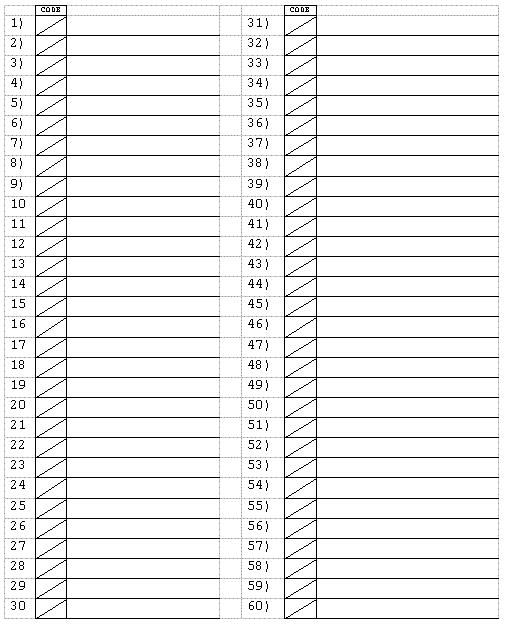
The code letters are used in the following ways: if a person
is a new guest or does not show up when his/her name is called,
the appropriate letter is placed in the upper left hand corner
of the code box. If a person shows later or departs early or
is asked to leave, the appropriate code letter should be placed
in the lower right hand corner of the code box. ALWAYS USE THE
UPPER LEFT HAND PORTION OF THE CODE BOX FIRST.
Explanation of the codes is as follows:
A = N e w G u e s t: This is a person who has never stayed
at the Hotel in the past. This person will be asked to arrive
30-l5 minutes prior to admission time so that an Intake Sheet
may be filled out and the House Rules and Policies explained.
This also alerts Data Entry personnel that this guest has not
been entered into the computer and that there should be an Intake-sheet
on this guest.
B = No Show: Indicates that a person did not come in at the
time his/her name was called at admission. If at the end of admission
time the person is still not here, he/she is-put on the outlist
for seven days.
C = Showed Later: This indicates that a person who did not
come in the first time his/her name was called did showup before
the end of admission time
D = Early Departure: This is used when a person leaves early
voluntarily. When this happens, the time of departure must be
noted on the Registration Form after the person's name. A person
who leaves early may be put on" the outlist depending upon
the reason for early departure.
E = Ejected: This code is used when a person is tasked to
leave for breaking house rules. The time of ejection must be
noted on the Registration Form after the person's name and an
entry into the log must be made.
F = Called. No Show: This is used when a person who has called
in to register decides not to come in that evening for one' reason
or another and calls before the end of admission time to cancel.
There is no penalty for doing this
H = Intake Sheet Needed: This letter indicates that an Intake
Sheet Is needed on a particular guest and should be done the
next time the guest comes in.
K = Motel Placement: This letter indicates that a particular
guest has been placed in a motel.
REGISTERING GUESTS EARLY
If a person has registered early, the person's name as well
is at the time he or she will be arriving should be written at
the bottom of that night's registration form. When the person
comes in the staff member who admits the guest must write "here"
after the person's name on the Registration Form
NIGHT MONITORS' PROCESS FOR MARKING THE REGISTRATION FORM
A. The Night Monitor, after circling the date of stay on the
record cards should put a dash (-) after the person's name on
the Registration Form.
B. The Night Monitor should only use a RED pen when marking
on the Registration Form whether that be after they have entered
a person onto the card or the book, or if they need to use a
code letter.
C. When the Night Monitor has completed this work he is to
sign the bottom of the Registration Form.
|
DATE: ______________ |
REGISTRATION FORM (Fall-Winter)
ST. Vincent Hotel |
MEN
A) New Guest, B) No Show,
C) Showed Later, D) Early Departure, E)
Ejected, F) Called, No Show
G) Not in Computer, H) No Guest
Information Sheet, I) Church, K)
Kettering
HOUSE COUNT
DATE ____________________________
|
EXITED GUESTS:
___________________ ___________________ ___________________
___________________
REFERRALS ________ |
TOTALS: |
CHILDREN _____________
ADULTS _____________
GRAND TOTAL __________ |
|
Page 1 |
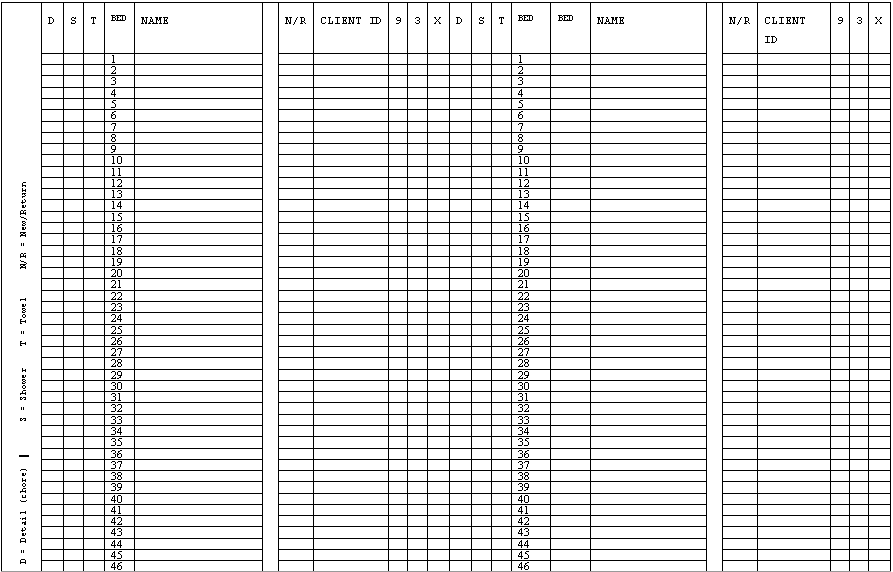
Men's Sign in |
Date: ___________________ |
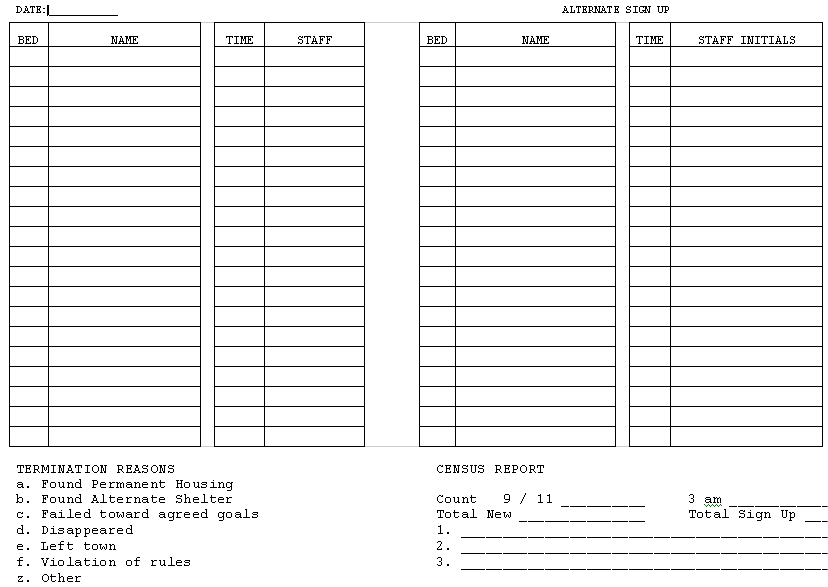
Men's Alternate List |
|
DATE _____________
9pm count ________
3am count ________
Total New ________ |
WOMEN'S SIGN IN SHEET
Total sign-in |
1____________________
2____________________
3____________________ |
|
Termination codes: |
A: Found permanent housing (moved out)
B: Found alternate shelter (call out)
D. Disappeared F:
Ban |
Z: Other
|
SAMARITAN HOUSE OF LIMA
 |